

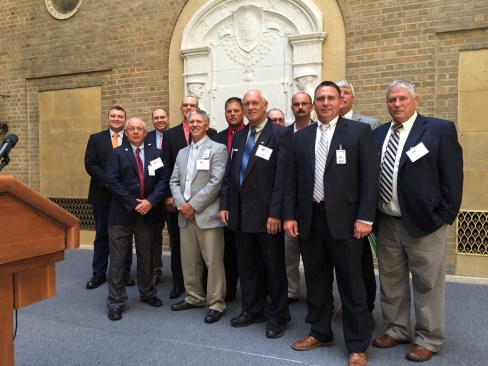
I had the opportunity to once again lead 12 farmers on a trip to Washington, D.C. to attend the USDA Lockup and Crop Report. I’m changing things up a little this week by showcasing one of the farmers who participated in the trip. Below is C.J. Fleenor’s guest blog post:
Recently, I was given the opportunity to cross an event off my “Bucket List.” We all have one: that list of random things we would like to accomplish, achieve or experience at some point. Washington, D.C., is truly an amazing city. I have been fortunate to travel there several times over the last few years, but there was still one thing I had not experienced…
The “D.C. Lockup.”
As farmers and people in agriculture, we know of the crop reports released by WASDE and NASS. It has always fascinated me how those reports can make billion-dollar changes in our pocketbooks and the general global economy.
When my regional manager approached me about Farm Bureau sponsoring an annual trip for the lockup, I didn’t think twice when I said “YES!” This was an opportunity to cross a bucket list item off for sure. However, I didn’t realize just how much went into that report. Nor did I realize how little was analyzed for such a monumental monthly document.
The Indiana Farm Bureau delegation, led by Kyle Cline, left on Thursday. Our day started with AFBF and a brief discussion on upcoming hot topics. From there, we travelled to the office of Chuck Conner and the National Council of Farmer Cooperatives, and visited the Canadian Embassy. We discussed U.S. agricultural issues, presidential politics and the importance of the TPP and trade. Our day was capped off with dinner and sightseeing of the beautiful city at night.
Friday, we headed to the USDA. After going through extensive security, we entered the pre-lockup room. There, we deposited any electronics, phones, watches, key fobs, etc., into lockers. Then we heard from NASS employees on how the report is generated. This is where I realized that more than 20,000 points of corn are gathered…equaling up to five acres total of corn. (It’s only one acre of soybeans!) From these sample sites, test weights, kernel quality, yield, etc., are gathered each month.
Then we experience the lock-up.
11 a.m. After passing through an electromagnetic scanner and two sets of locked doors, we hear from statisticians and get a tour. They come in to analyze the data and compile the report just before midnight and can’t leave until the report is released.
11:30 a.m.: We enter the briefing room, where we read the report and speculate on its impact on the markets.
11:45 a.m.: The secretary of agriculture or his designee – in our case, the chief economist – enters the room and the official briefing begins.
Noon: The report is released and the statisticians may leave.
Everything concludes by 12:30 p.m. There were no windows, no doors outside and no communication with the outside world.
I always envisioned this as a general media report; the briefing aspect was interesting. It was a true government briefing, and we were there to witness as the chief economist realized the impact that the decreased expected fall price would have upon ARC and PLC payments, among other supply/demand concerns.
Ultimately, this was a once in a lifetime opportunity, and I would strongly encourage any member to consider attending. The security, the process, the methodology and the presentation were amazing. Not to mention getting to read a copy of the August crop report before anybody else had! I greatly appreciate Kyle and the Indiana Farm Bureau allowing me this opportunity!
C.J. Fleenor, Orange County Farm Bureau President
 Hoosier on the Hill