USDA Lockup: A Farmer’s Viewpoint

img_2269

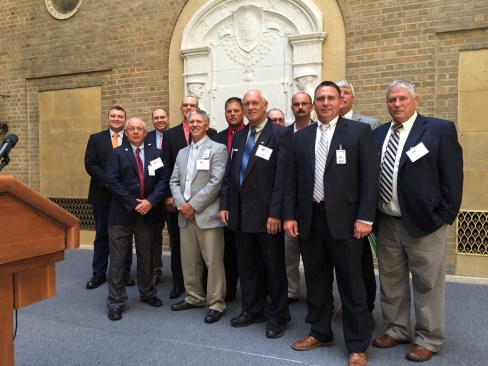
I had the opportunity to once again lead 12 farmers on a trip to Washington, D.C. to attend the USDA Lockup and Crop Report. I’m changing things up a little this week by showcasing one of the farmers who participated in the trip. Below is C.J. Fleenor’s guest blog post:

Recently, I was given the opportunity to cross an event off my “Bucket List.” We all have one: that list of random things we would like to accomplish, achieve or experience at some point. Washington, D.C., is truly an amazing city. I have been fortunate to travel there several times over the last few years, but there was still one thing I had not experienced…

The “D.C. Lockup.”

As farmers and people in agriculture, we know of the crop reports released by WASDE and NASS. It has always fascinated me how those reports can make billion-dollar changes in our pocketbooks and the general global economy.

When my regional manager approached me about Farm Bureau sponsoring an annual trip for the lockup, I didn’t think twice when I said “YES!” This was an opportunity to cross a bucket list item off for sure. However, I didn’t realize just how much went into that report. Nor did I realize how little was analyzed for such a monumental monthly document.

The Indiana Farm Bureau delegation, led by Kyle Cline, left on Thursday. Our day started with AFBF and a brief discussion on upcoming hot topics. From there, we travelled to the office of Chuck Conner and the National Council of Farmer Cooperatives, and visited the Canadian Embassy. We discussed U.S. agricultural issues, presidential politics and the importance of the TPP and trade. Our day was capped off with dinner and sightseeing of the beautiful city at night.

Friday, we headed to the USDA. After going through extensive security, we entered the pre-lockup room. There, we deposited any electronics, phones, watches, key fobs, etc., into lockers. Then we heard from NASS employees on how the report is generated. This is where I realized that more than 20,000 points of corn are gathered…equaling up to five acres total of corn. (It’s only one acre of soybeans!) From these sample sites, test weights, kernel quality, yield, etc., are gathered each month.

Then we experience the lock-up.

11 a.m. After passing through an electromagnetic scanner and two sets of locked doors, we hear from statisticians and get a tour. They come in to analyze the data and compile the report just before midnight and can’t leave until the report is released.

11:30 a.m.: We enter the briefing room, where we read the report and speculate on its impact on the markets.

11:45 a.m.: The secretary of agriculture or his designee – in our case, the chief economist – enters the room and the official briefing begins.

Noon: The report is released and the statisticians may leave.

Everything concludes by 12:30 p.m. There were no windows, no doors outside and no communication with the outside world.

I always envisioned this as a general media report; the briefing aspect was interesting. It was a true government briefing, and we were there to witness as the chief economist realized the impact that the decreased expected fall price would have upon ARC and PLC payments, among other supply/demand concerns.

Ultimately, this was a once in a lifetime opportunity, and I would strongly encourage any member to consider attending. The security, the process, the methodology and the presentation were amazing. Not to mention getting to read a copy of the August crop report before anybody else had! I greatly appreciate Kyle and the Indiana Farm Bureau allowing me this opportunity!
C.J. Fleenor, Orange County Farm Bureau President
img_2272

Grassroots Advocacy in Action

Welcome!

I am Kyle Cline, your Hoosier on the Hill.  I’m excited to get this blog going and share my passion for public policy, government and all things agriculture.  I will be your host as we examine the issues and stories coming out of Washington, D.C. that impact American farmers and their rural communities.  In this first post, I highlight the annual Indiana Farm Bureau Leader Trip to Washington, D.C.

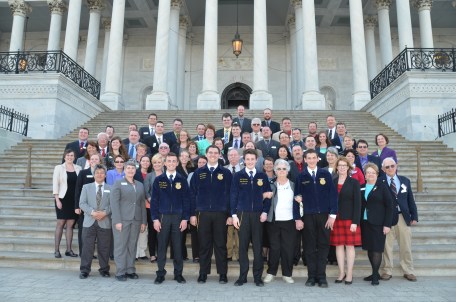
2-DC trip-DSC_7087-JAW

Each year, Indiana Farm Bureau members descend on Capitol Hill for the annual Leader Trip to Washington, D.C.  This trip is a prime opportunity for INFB members to participate in leadership development, issue education and to engage in some good old fashioned grassroots advocacy, including visits with their federal elected officials.  This year, the Leader Trip took place March 22-24 and included participation from 56 members.

The agenda may change from year to year, but the Leader Trip always includes plenty of opportunities for education on Farm Bureau’s national priority issues.  On day 1, our members arrived bright and early in Washington, D.C. and were greeted by the colorful cherry blossoms which were on full display the entire week.  Our first stop was a visit to the American Farm Bureau Federation. Members learned about the latest legislative and regulatory updates on some of the most pressing agricultural issues including biotechnology and GMO labeling, regulatory reform, trade and Trans-Pacific Partnership (TPP), farm policy and tax reform.  After hearing from INFB staff on advocacy “best practices” and planning their congressional visits for the next day, the Leader Trip participants set off on foot for the USDA, where the group heard from Acting Deputy Secretary Michael Scuse, Assistant Secretary for Congressional Relations Todd Batta, and Farm Service Agency Administrator Val Dolcini.  The discussions during this segment included international trade and TPP, farm policy, conservation and many other current issues.  Following the briefings, Leader Trip participants had an unexpected opportunity to tour USDA Secretary Vilsack’s office, which was possible because the secretary happened to be visiting Cuba with the president and other leaders.

haugheecapture nagaicapture

Day 2 of the Leader Trip was the official Capitol Hill Day.  Farm Bureau members took their new knowledge as well as their own unique perspectives and stories from their farms and communities and delivered a grassroots message to Congress about the importance of agriculture.  Members were organized in groups by congressional districts and had the opportunity to meet with their congressman/congresswoman to ask them for their support on Farm Bureau’s priority issues and legislation.

brookscapture

Representatives Luke Messer and Susan Brooks even took a few minutes away from their busy schedules to talk to us about the importance of constituent involvement in the legislative process and how office visits in D.C. are helpful to their work.  Their message re-confirms the positive difference that Farm Bureau and its members are making everyday.

messercapture

In the afternoon, our group visited the Senate Agriculture Committee and heard from Chief Economist Matt Erickson and Chief Counsel Anne Hazlett, both Hoosiers making a big difference on Capitol Hill for agriculture.  Last but not least, the group met up with the Iowa Farm Bureau in the afternoon for a session on renewable fuels and the future of farm policy.  Iowa Farm Bureau members were in town for their own version of the Leader Trip.

On Day 3, our members grabbed their passports and went global by paying a visit to the Embassy of Japan.  As an important trading partner and key nation in the proposed TPP, a visit with Japan made perfect sense.  Much of the discussion with Japanese officials focused on TPP and the importance of ensuring passage by Congress before the end of the year.  Japan plans to consider TPP for a vote in their parliament likely sometime in early summer.  The discussion was a good reminder to our members about how important international trade is to their bottom lines and profitability on the farm.  In a time when farm incomes have dropped 56% since 2013, more trade and market access for our products will be needed to get out of the hard times.  In Indiana alone, AFBF estimates an increase in cash receipts by $196 million and net exports by $98.3 million annually.  The largest gains will be in the soybean, corn, pork and beef sectors.

Overall, the 2016 Leader Trip was a success.  It is inspiring to me and the rest of the INFB staff to see current and future Farm Bureau leaders taking ownership of their destiny as they become effective advocates for agriculture.  It is empowering to see the effects of grassroots advocacy in action and the difference Farm Bureau makes when a few of us come together around a common cause.