The Scoop on August Recess

Capitol-Reflection

Every August, federal lawmakers return home to meet with constituents and spend time with family during what is commonly known as the congressional “August recess,” also referred to as a congressional work period. These meetings offer citizens and organizations such as the Indiana Farm Bureau an opportunity to meet face-to-face with their senators and representatives and speak about the issues that are on their mind. For example, this year Farm Bureau’s top priority is the Trans-Pacific Partnership (TPP). Hoosier farmers are also talking about tax and regulatory reform. More information about INFB’s August Recess activities can be found on the website.

You might be wondering why Congress needs a special month-long break or the origin of this tradition. I found myself asking the same questions, so I decided to do a little research to learn more. I will save you all of the details by providing you with the link to the full story. But first, just a few highlights on the history of August Recess for those of you with limited time on your hands.

  • Congress has adjourned for summer breaks dating all the way back to 1791. Of course, it wasn’t until the 20th century that federal lawmaking was a full-time position. Until that time, lawmakers worked other jobs as well, including many farmers.
  • In 1841 congress experienced its first full Washington summer due to an usually large work load. Shortly after the start of the 20th century, this became normal practice (imagine that for a moment, D.C. in the summertime with no air-conditioning!).
  • A mandated recess was so important to congress that it passed the Legislative Reorganization Act in 1970, establishing August recess in statute. You might think of it as America’s only required vacation.
  • The reason for this change had to do with the fact that junior members of congress with young families lobbied more senior members for more predictability in the legislative schedule so they could plan their vacations and ensure valuable time spent with their spouses and children.
  • The late 1960’s were especially tasking on congressional members given a series of notable activities that demanded their time such as the Vietnam War, President Lyndon B. Johnson’s “war on poverty” and social reform agenda.
  • Under the constitution, the Senate and House cannot recess for more than 3 days without the other’s permission.
  • In addition to meeting with constituents back home, members have the opportunity to spend some well-deserved time off with family as well.

Ag Luncheon at Bloomberg

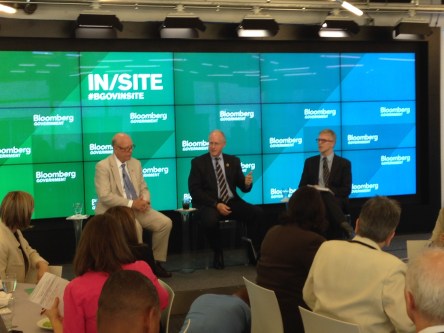
This week, farm policy took center stage during my trip to our nation’s capital.  At a luncheon hosted by Bloomberg Government, Senate Agriculture Committee Chairman Pat Roberts and House Agriculture Committee Chairman Mike Conaway discussed the future of the farm bill as well as other critical challenges facing the ag sector.  Not surprisingly, these included: agricultural economy and commodity markets, new realities and pressures related to farm incomes, growing regulatory burdens and emerging agriculture technologies.

House Ag Chairman Conaway is currently leading a series of congressional hearings on these emerging pressures on rural America and he is pro-actively working to ensure that these issues remain in front of fellow colleagues on Capitol Hill as well as the general public.  Conaway has also been using other opportunities and forums to promote key agricultural issues and is serving as an advocate for the American farmer as seen in a recent Bloomberg opinion piece.

IMG_4146

At the luncheon Chairman Conaway also took time to publicly praise the hard work and leadership of Indiana Congresswoman Jackie Walorski.  As the Nutrition Sub-Committee Chair, Rep. Walorski has helped lead several of the hearings within the House Ag Committee and focused on important issues such as the Supplemental Nutrition Assistance Program (SNAP) reform and the connections between farm policy and food prices.  Additionally, the issue of poverty and relation to agriculture and food prices has been well documented and discussed among congressional leaders as of late and was another point of emphasis by Chairman Conaway.  He highlighted a new report called “A Better Way”, which was spearheaded by House Speaker Paul Ryan, Chairman Conaway and other Republican leaders.

In addition to recent hearings and activities, chairmen Roberts and Conaway also discussed a number of specific policy issues including the future of the farm bill.  Both agreed that before any potential changes are made to the next farm bill, congressional leaders should agree to establish rigorous policy standards to determine impacts on food prices and availability.  As Chairman Conaway explained, any policy found to potentially increase food cost needs to have clear goals and justifiable, widespread benefits.

Another area of agreement and emphasis by chairmen Roberts and Conaway was crop insurance and the important role that it should continue to play in the next farm bill.  Despite repeated attempts to reduce crop insurance support by a handful of lawmakers as well as President Obama in recent times, the agriculture community has been successful at thwarting these counterproductive efforts.  However, these battles are not finished and it should be expected that they will continue and only increase as we get closer to the development of the next farm bill.  They also noted that the next farm bill needs to continue an overall safety net that is robust and includes support for both crop insurance as well as commodity programs because agriculture is very diverse across our country and different farmers have different needs.

In closing, the chairmen noted that the next farm bill will likely be written during a very difficult farm economy scenario while at the same time undergoing increasing baseline and budgetary scrutiny, creating a lot of pressures.  In addition to risk management tools and safety net discussions about crop insurance and commodity programs, the growing issue of credit availability for farmers is another important consideration in the overall picture.  While discussions are increasing about what the next farm bill should be, the verdict is still very much out about how the current farm bill is serving farmers and rural communities.  Any attempts to change the farm bill should first and foremost be market oriented and consider food affordability and availability.

Moving forward, the ag committees will continue congressional hearings and activities to highlight key agricultural issues that impact farm policy.  They also plan to host listening sessions with key interests groups and farmers across the U.S. beginning at the end of the year.  Indiana Farm Bureau will follow these developments closely and communicate about opportunities as they become available.

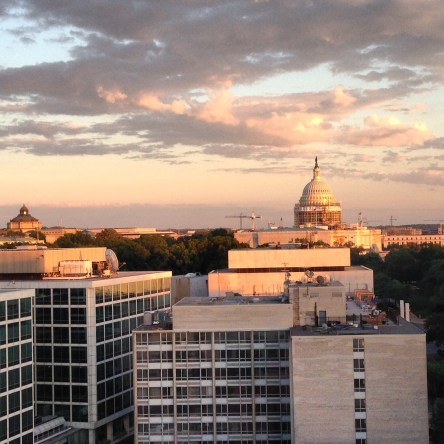
IMG_0029(View from my hotel on New Jersey St.)

A Day (or Three) in the Life of a Lobbyist

Welcome back to Hoosier on the Hill!

In this post, I highlight my recent trip to Washington, D.C., which took place earlier this week.  While it is difficult to pinpoint a typical day as a lobbyist, this trip provides a pretty good flavor for some typical activities on the job.

Day 1
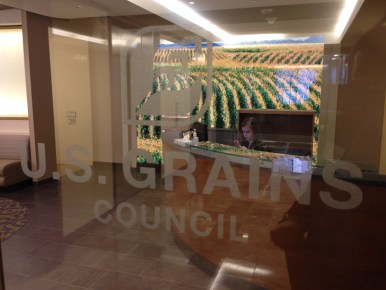
Tuesday was primarily focused on issue education, research and relationship building. After landing at the airport and taking the metro directly to the hotel, I checked in, dropped off my bag and headed off to my first meeting at the U.S. Grains Council (USGC).
A little bit of history for you, the USGC was founded in 1960 as a private, non-profit corporation with 10 international offices and programs in more than 50 countries. Its membership includes producer organizations and agribusinesses with a common interest in developing export markets primarily for U.S. barley, corn, grain sorghum and related products, including ethanol and distiller’s dried grains with solubles (DDGS).  The mission of the USGC is to develop markets, enable trade and improve lives.
IMG_3986
The focus of my meeting at the USGC was on international trade, a high priority issue for Indiana Farm Bureau and our 72,000 farmer members. The USGC is a partner with Farm Bureau in the Trade Benefits America and U.S. Coalition for Trans-Pacific Partnership (TPP), a broad-based and cross-sectoral coalition of U.S. companies and organizations urging Congress to pass TPP.  I had the opportunity to meet with USGC’s Director of Trade Policy to discuss the latest trade-related updates and other upcoming activities of mutual interest. Trade will continue to be a priority issue over the course of the year for Farm Bureau.  In fact, May is World Trade Month, and my next blog post will cover some of the activities and resources available to INFB members to promote this important issue.

After the meeting at USGC, I headed outside to order an Uber and fought D.C. traffic to get to my next meeting in the Georgetown area.  I quickly shifted my attention from trade and TPP to livestock issues.  This meeting consisted of a discussion related to the latest major announcements by large food manufacturers and retail companies regarding animal welfare requirements, namely cage-free eggs. We also touched on the proposed rule from the USDA related to animal welfare requirements for organic livestock producers.  Farm Bureau continues to evaluate the proposed rule for impacts, but has already requested an extension to the comment period to ensure the USDA receives adequate feedback from the producers as well as the general public.

Day 2
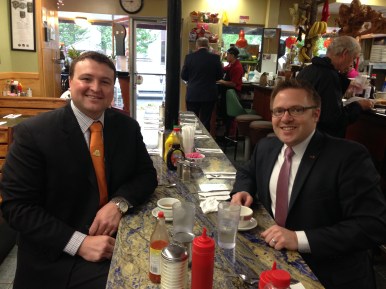
Before my busy day of meetings on Capitol Hill, I had a chance to meet up with a friend and colleague from the Michigan Farm Bureau, John Kran, for breakfast at Pete’s Diner.  Pete’s is one of John Boehner’s favorite breakfast spots and word has it, a favorite of other members of congress.  So we thought we’d give it a try.  While very small and unassuming, Pete’s provides basic but tasty comfort food for a good price.  I recommend the omelets which come standard with a side of French fries.  It’s always great to get together with our friends from other state Farm Bureaus and hear the latest issues impacting their members.
IMG_4004
A day on Capitol Hill is always very fast-paced and requires close attention to the schedule, time and the issues that we want our members of congress to hear about.  I visited with each office in the Indiana congressional delegation on several issues including biotechnology labeling, trade, rail infrastructure and the Affordable Care Act.

After being on the job for nearly three years (boy does time fly!), I listened to my wife and slowed down between meetings to snap a few pictures of my surroundings, which I know I’m guilty of taking for granted from time to time.

Day 3
On Thursday, I attended a training session at AFBF on the topic of grassroots engagement.  The AFBF public policy staff probably described the primary job functions of a lobbyist best:

  • Education (of others as well as yourself)
  • Sales
  • Research
  • Public relations and communications
  • Networking and relationship building and management

As I reviewed the list, I realized that I touched on all five functions during the course of my trip.  The training also included best practices for member advocacy and engagement, the do’s and don’ts from the congressional staff perspective, Capitol Hill visits, a simulation of what it is like to be a member of Congress and how to tell effective stories (guidelines taken directly from the Disney model).

After a full day of training, I grabbed my suitcase and descended down the long escalator to the metro to go back to the airport.  Upon reaching my departure gate, I met up with Senator Joe Donnelly and had a chance to briefly catch up before boarding the plane.  After a smooth flight to Indy and another hour and 15 minute drive, I finally arrived home around 10:00 p.m. where I was met at the doorstep by my three favorite people, anxiously waiting to hear all about my trip and discover what goodies I brought home in my suitcase.  Just another day in my life as a lobbyist.