Setting the Stage for the Next Farm Bill

Over the years, the agriculture industry and farming have evolved in very positive ways, but have also faced a myriad of growing economic, environmental and social challenges that did not exist at the levels they do today. As a result, there is no shortage of policy issues for the modern farmer and agricultural advocate to engage. For example, environmental policy and regulatory pressures, transportation and infrastructure funding, international trade, tax reform, immigration, healthcare and energy, just to name a few.

However, despite all of these growing complexities and issues impacting the farm, one policy issue continues to stand above the rest, and that of course is the farm bill. Over the last several months, agriculture and non-agricultural groups alike have been lining up to make statements, publish reports, and blast the airwaves with the issues of the farm bill they find most important to their members or stakeholders.

Farm Bureau is also in the process of taking deliberate steps to ensure that the farm bill continues to work for the American farmer. The American Farm Bureau Federation (AFBF) has appointed an advisory group consisting of state staff, including Indiana, to discuss what’s working in the current farm bill and what isn’t. The working group, along with AFBF staff, has published over 50 policy background papers and several videos on various issues and individual titles of the farm bill for farmer members to review. The goal is to prepare farmers for discussions about what they would like to see in the next farm bill so that Farm Bureau can effectively advocate for their needs.

At the state level, Indiana Farm Bureau (INFB) is also developing a process to receive grassroots feedback and policy to shape the next farm bill. A survey has been launched for Indiana Farm Bureau members, a state-level working group has been established consisting of farmer volunteers, and a series of educational seminars and listening sessions have been scheduled with partners at Purdue University. All of these activities culminate to the annual INFB state convention in December, where there will be a farm bill listening session followed by the delegate session where policies will be considered and voted on.

Many other state Farm Bureaus are also planning similar activities and outreach to their farmer members and families. If you live outside of Indiana, you are encouraged to contact your own state Farm Bureau staff to learn more.

There is no doubt that we are going through challenging times in farm country right now. Many farm families are dipping into reserves as they face prices at break-even levels or below. According to the USDA, net farm income for 2016 is at $54.8 billion, compared to $123.3 billion in 2013. Despite these harsh realities, there is no shortage of critics calling attention to the amount of risk management funds going to farm families at this critical time. Yet this is exactly how the farm safety net is designed to work. It pays during times of serious economic decline and does not pay out when the farm economy is on more sound footing. Current budget projections indicate we are likely to have less money to spend on the next farm bill than we had when we wrote the last one. So farmer engagement and grassroots feedback is more critical than ever to assist Farm Bureau in the prioritization of programs.

AFBF President Zippy Duvall has used the metaphor of the farm bill as a barn-raising. He states that “this barn raising is one of the biggest events coming up on the ag calendar, and it’s important that we do everything in our power to make sure Congress gets it right, with squared-up corners and leveled-up beams.” A proper barn-raising in this context is not complete or successful without the participation of the entire community. Farm Bureau and agriculture need farmers to step up and ensure that our collective futures are served by a properly functioning national farm policy. Take the first step and check out the resources and activities that can help you engage and shape this future by visiting http://www.fb.org/farmbillresources/.
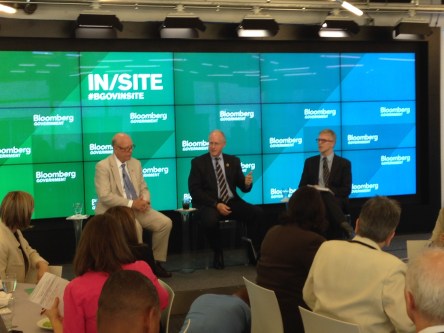

Ag Luncheon at Bloomberg

This week, farm policy took center stage during my trip to our nation’s capital.  At a luncheon hosted by Bloomberg Government, Senate Agriculture Committee Chairman Pat Roberts and House Agriculture Committee Chairman Mike Conaway discussed the future of the farm bill as well as other critical challenges facing the ag sector.  Not surprisingly, these included: agricultural economy and commodity markets, new realities and pressures related to farm incomes, growing regulatory burdens and emerging agriculture technologies.

House Ag Chairman Conaway is currently leading a series of congressional hearings on these emerging pressures on rural America and he is pro-actively working to ensure that these issues remain in front of fellow colleagues on Capitol Hill as well as the general public.  Conaway has also been using other opportunities and forums to promote key agricultural issues and is serving as an advocate for the American farmer as seen in a recent Bloomberg opinion piece.

IMG_4146

At the luncheon Chairman Conaway also took time to publicly praise the hard work and leadership of Indiana Congresswoman Jackie Walorski.  As the Nutrition Sub-Committee Chair, Rep. Walorski has helped lead several of the hearings within the House Ag Committee and focused on important issues such as the Supplemental Nutrition Assistance Program (SNAP) reform and the connections between farm policy and food prices.  Additionally, the issue of poverty and relation to agriculture and food prices has been well documented and discussed among congressional leaders as of late and was another point of emphasis by Chairman Conaway.  He highlighted a new report called “A Better Way”, which was spearheaded by House Speaker Paul Ryan, Chairman Conaway and other Republican leaders.

In addition to recent hearings and activities, chairmen Roberts and Conaway also discussed a number of specific policy issues including the future of the farm bill.  Both agreed that before any potential changes are made to the next farm bill, congressional leaders should agree to establish rigorous policy standards to determine impacts on food prices and availability.  As Chairman Conaway explained, any policy found to potentially increase food cost needs to have clear goals and justifiable, widespread benefits.

Another area of agreement and emphasis by chairmen Roberts and Conaway was crop insurance and the important role that it should continue to play in the next farm bill.  Despite repeated attempts to reduce crop insurance support by a handful of lawmakers as well as President Obama in recent times, the agriculture community has been successful at thwarting these counterproductive efforts.  However, these battles are not finished and it should be expected that they will continue and only increase as we get closer to the development of the next farm bill.  They also noted that the next farm bill needs to continue an overall safety net that is robust and includes support for both crop insurance as well as commodity programs because agriculture is very diverse across our country and different farmers have different needs.

In closing, the chairmen noted that the next farm bill will likely be written during a very difficult farm economy scenario while at the same time undergoing increasing baseline and budgetary scrutiny, creating a lot of pressures.  In addition to risk management tools and safety net discussions about crop insurance and commodity programs, the growing issue of credit availability for farmers is another important consideration in the overall picture.  While discussions are increasing about what the next farm bill should be, the verdict is still very much out about how the current farm bill is serving farmers and rural communities.  Any attempts to change the farm bill should first and foremost be market oriented and consider food affordability and availability.

Moving forward, the ag committees will continue congressional hearings and activities to highlight key agricultural issues that impact farm policy.  They also plan to host listening sessions with key interests groups and farmers across the U.S. beginning at the end of the year.  Indiana Farm Bureau will follow these developments closely and communicate about opportunities as they become available.

IMG_0029(View from my hotel on New Jersey St.)