Setting the Stage for the Next Farm Bill

Over the years, the agriculture industry and farming have evolved in very positive ways, but have also faced a myriad of growing economic, environmental and social challenges that did not exist at the levels they do today. As a result, there is no shortage of policy issues for the modern farmer and agricultural advocate to engage. For example, environmental policy and regulatory pressures, transportation and infrastructure funding, international trade, tax reform, immigration, healthcare and energy, just to name a few.

However, despite all of these growing complexities and issues impacting the farm, one policy issue continues to stand above the rest, and that of course is the farm bill. Over the last several months, agriculture and non-agricultural groups alike have been lining up to make statements, publish reports, and blast the airwaves with the issues of the farm bill they find most important to their members or stakeholders.

Farm Bureau is also in the process of taking deliberate steps to ensure that the farm bill continues to work for the American farmer. The American Farm Bureau Federation (AFBF) has appointed an advisory group consisting of state staff, including Indiana, to discuss what’s working in the current farm bill and what isn’t. The working group, along with AFBF staff, has published over 50 policy background papers and several videos on various issues and individual titles of the farm bill for farmer members to review. The goal is to prepare farmers for discussions about what they would like to see in the next farm bill so that Farm Bureau can effectively advocate for their needs.

At the state level, Indiana Farm Bureau (INFB) is also developing a process to receive grassroots feedback and policy to shape the next farm bill. A survey has been launched for Indiana Farm Bureau members, a state-level working group has been established consisting of farmer volunteers, and a series of educational seminars and listening sessions have been scheduled with partners at Purdue University. All of these activities culminate to the annual INFB state convention in December, where there will be a farm bill listening session followed by the delegate session where policies will be considered and voted on.

Many other state Farm Bureaus are also planning similar activities and outreach to their farmer members and families. If you live outside of Indiana, you are encouraged to contact your own state Farm Bureau staff to learn more.

There is no doubt that we are going through challenging times in farm country right now. Many farm families are dipping into reserves as they face prices at break-even levels or below. According to the USDA, net farm income for 2016 is at $54.8 billion, compared to $123.3 billion in 2013. Despite these harsh realities, there is no shortage of critics calling attention to the amount of risk management funds going to farm families at this critical time. Yet this is exactly how the farm safety net is designed to work. It pays during times of serious economic decline and does not pay out when the farm economy is on more sound footing. Current budget projections indicate we are likely to have less money to spend on the next farm bill than we had when we wrote the last one. So farmer engagement and grassroots feedback is more critical than ever to assist Farm Bureau in the prioritization of programs.

AFBF President Zippy Duvall has used the metaphor of the farm bill as a barn-raising. He states that “this barn raising is one of the biggest events coming up on the ag calendar, and it’s important that we do everything in our power to make sure Congress gets it right, with squared-up corners and leveled-up beams.” A proper barn-raising in this context is not complete or successful without the participation of the entire community. Farm Bureau and agriculture need farmers to step up and ensure that our collective futures are served by a properly functioning national farm policy. Take the first step and check out the resources and activities that can help you engage and shape this future by visiting http://www.fb.org/farmbillresources/.

Congress Avoids Shutdown, Tees Up Water Infrastructure Funding Before Leaving Town

This past week was a busy one for congress, as members scrambled to complete several key items prior to their scheduled break that will last until after elections. Below is a brief rundown of these provisions and the latest developments of interest to the world of agriculture.

Stop-Gap Funding Bill Passes Congress, Government Shutdown Averted For Now

In recent years, a brief government shutdown or the threat of one has become quite commonplace and expected on an annual basis. However, the fact that it is a key election year means that neither party has much appetite at all to play “hard ball” and be responsible for shutting the government down. In the end, The House passed legislation, 342-85, to avoid a government shutdown which would have occurred on September 30 if no deal was struck. The bill, which was easily passed by the Senate 72-26 earlier on Wednesday and has White House backing, would fund the federal government through Dec. 9, provide $1.1 billion to combat the Zika virus and send $500 million to Louisiana and other states facing natural disasters. One of the reasons that this legislation came down to the end of the wire was that Democrats demanded funding in the spending package for the water infrastructure problems faced by Flint, Michigan as well as other communities. After weeks of stalemate on that issue, a deal was reached by party leadership to address funding for Flint during the lame-duck session when congress returns to Washington, D.C. post-election. That funding will be considered as an amendment in a separate water infrastructure bill that I discuss below.

Waterway Infrastructure Bills Clear House, Senate

Earlier this week, the U.S. House passed a water infrastructure bill by a strong vote of 399-25. The Water Resources Development Act of 2016 companion legislation passed the Senate easily by a margin of 95-3 earlier in the month. The legislation would clear the backlog of port and waterway project authorizations and set in motion 25 projects for the U.S. Army Corps of Engineers, seven of which are navigation focused, among other things. Final passage in the House would have occurred earlier but negotiations were ongoing regarding how to handle funding for Flint, Michigan which stalled the process.

While both chambers firmly recognized the need for improved investment in our waterways infrastructure in the U.S., some differences remain between both bills. The House version limits funding and projects to Corps of Engineers projects exclusively, while the Senate bill included provisions dealing with the Clean Water Act, wastewater programs and water safety measures. Overall, however, these latest efforts demonstrate that awareness of our nation’s waterways infrastructure challenges is growing in congress and members are receptive to fixing them. Both chambers are expected to conference their respective bills during the lame-duck session with the hopes of delivering the legislation to the president for signature by the end of the year.

This issue is especially important to Hoosier farmers since so much of our competitiveness on a national and global stage is directly tied to efficiencies in sound infrastructure. According to the American Farm Bureau Federation, Over 60 percent of America’s grain exports and many other important commodities such as fuel, coal and agricultural inputs also move through our inland waterway system. Due to this importance, Farm Bureau policy explicitly supports the maintenance and improvement of our transportation infrastructure including the lock and dam system and other vital waterway infrastructure.

Court Strikes Down OSHA Memo Impacting Anhydrous Ammonia Retailers

Late last week the D.C. Court of Appeals ruled that the Occupational Safety and Health Administration (OSHA) had violated the Occupational Safety and Health (OSH) Act and the Administrative Procedures Act (APA) when it issued an enforcement memorandum on July 22, 2015, redefining the longstanding retail facility exemption to the Process Safety Management Standard (PSM) for facilities that sell anhydrous ammonia. The decision vacates the memorandum and requires OSHA to go through formal notice and comment rulemaking procedures to make any changes to the PSM regulations as it relates to agricultural retailers. According to the Ag Retailers Association, the timely court decision will save U.S. retailers an estimated $100 million in compliance costs. Process Safety Management applies to any facility storing 10,000 pounds or more of anhydrous ammonia. However, retail agriculture facilities selling more than 50 percent of the fertilizer to farmers have been exempt from PSM. OSHA’s 2015 memo eliminated the exemption.

Packers, Stockyards to See Some Modernization

This week the Senate passed by unanimous consent H.R. 5883, the Clarification of Treatment of Electronic Sales of Livestock Act of 2016. The bill is identical to S. 3350 introduced by Sens. Thad Cochran (R-Miss.) and John Tester (D-Mont.) which was quickly approved by the upper chamber after House passage.

The White House is expected to sign the bill, which will expand packers and stockyards definitions to include the use of Internet and video auctions and update payment methods to include the use of electronic fund transfers.

The Scoop on August Recess

Capitol-Reflection

Every August, federal lawmakers return home to meet with constituents and spend time with family during what is commonly known as the congressional “August recess,” also referred to as a congressional work period. These meetings offer citizens and organizations such as the Indiana Farm Bureau an opportunity to meet face-to-face with their senators and representatives and speak about the issues that are on their mind. For example, this year Farm Bureau’s top priority is the Trans-Pacific Partnership (TPP). Hoosier farmers are also talking about tax and regulatory reform. More information about INFB’s August Recess activities can be found on the website.

You might be wondering why Congress needs a special month-long break or the origin of this tradition. I found myself asking the same questions, so I decided to do a little research to learn more. I will save you all of the details by providing you with the link to the full story. But first, just a few highlights on the history of August Recess for those of you with limited time on your hands.

  • Congress has adjourned for summer breaks dating all the way back to 1791. Of course, it wasn’t until the 20th century that federal lawmaking was a full-time position. Until that time, lawmakers worked other jobs as well, including many farmers.
  • In 1841 congress experienced its first full Washington summer due to an usually large work load. Shortly after the start of the 20th century, this became normal practice (imagine that for a moment, D.C. in the summertime with no air-conditioning!).
  • A mandated recess was so important to congress that it passed the Legislative Reorganization Act in 1970, establishing August recess in statute. You might think of it as America’s only required vacation.
  • The reason for this change had to do with the fact that junior members of congress with young families lobbied more senior members for more predictability in the legislative schedule so they could plan their vacations and ensure valuable time spent with their spouses and children.
  • The late 1960’s were especially tasking on congressional members given a series of notable activities that demanded their time such as the Vietnam War, President Lyndon B. Johnson’s “war on poverty” and social reform agenda.
  • Under the constitution, the Senate and House cannot recess for more than 3 days without the other’s permission.
  • In addition to meeting with constituents back home, members have the opportunity to spend some well-deserved time off with family as well.

Big Week Ahead for Biotech

After months of negotiations, Senate leaders finally reached a historic deal in late June to set national labeling standards for foods that contain genetically engineered ingredients.

The agreement between Senate Agriculture Chairman Pat Roberts and ranking Democrat Debbie Stabenow caps off a long and winding path of negotiations that included a series of starts and stops.  Farm Bureau is supporting the Roberts-Stabenow GMO food labeling compromise and is currently asking members to contact Congress to urge for the bill’s passage.

Below is a rundown of what the legislation would actually do:

  • The legislation would block Vermont’s GMO labeling law that took effect July 1, protecting interstate commerce. States would not be allowed to have labeling laws that differ from the federal standard.
  • It would require food companies to disclose biotech ingredients but provides one of three options for doing so: 1) a scannable code, such as the QR codes on labels that can be read by smartphones, 2) on-package symbol or 3) text on the package indicating the presence of biotechnology.
  • Small companies would be exempt from the labeling requirements.
  • Meat and dairy products also would be exempt from the disclosure standards. Eating biotech feed wouldn’t be enough to qualify as a biotech product.
  • Provides USDA the authority to determine what on-package disclosure will look like.
  • Includes a narrow and strong definition of biotechnology that protects future breeding technologies from being stigmatized as being GMO.
  • Establishes that a manufacturer cannot label a product as non-GMO simply because it is not subject to the bill’s labeling requirements.
  • Also establishes that products already qualified as certified organic will be able to market as non-GMO.
  • Saves the average consumer hundreds of dollars each year.

Time is limited for Congress to take action on the legislation prior to July 15, when both chambers are scheduled for an extended break due to party conventions and August Recess. However, the process for approval is already underway.  Last week, the Senate voted 68-29 on a procedural motion that initiates the process for floor action.  There will be one more procedural vote to “invoke cloture”  followed by final consideration and a vote on the bill, which may take place next Friday, July 8 according to sources.  Assuming everything goes as anticipated, the House is expected to take action on the legislation during the week of July 11.


Ag Luncheon at Bloomberg

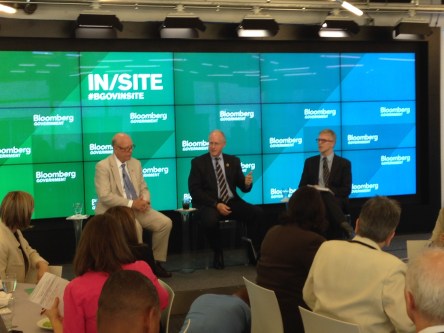
This week, farm policy took center stage during my trip to our nation’s capital.  At a luncheon hosted by Bloomberg Government, Senate Agriculture Committee Chairman Pat Roberts and House Agriculture Committee Chairman Mike Conaway discussed the future of the farm bill as well as other critical challenges facing the ag sector.  Not surprisingly, these included: agricultural economy and commodity markets, new realities and pressures related to farm incomes, growing regulatory burdens and emerging agriculture technologies.

House Ag Chairman Conaway is currently leading a series of congressional hearings on these emerging pressures on rural America and he is pro-actively working to ensure that these issues remain in front of fellow colleagues on Capitol Hill as well as the general public.  Conaway has also been using other opportunities and forums to promote key agricultural issues and is serving as an advocate for the American farmer as seen in a recent Bloomberg opinion piece.

IMG_4146

At the luncheon Chairman Conaway also took time to publicly praise the hard work and leadership of Indiana Congresswoman Jackie Walorski.  As the Nutrition Sub-Committee Chair, Rep. Walorski has helped lead several of the hearings within the House Ag Committee and focused on important issues such as the Supplemental Nutrition Assistance Program (SNAP) reform and the connections between farm policy and food prices.  Additionally, the issue of poverty and relation to agriculture and food prices has been well documented and discussed among congressional leaders as of late and was another point of emphasis by Chairman Conaway.  He highlighted a new report called “A Better Way”, which was spearheaded by House Speaker Paul Ryan, Chairman Conaway and other Republican leaders.

In addition to recent hearings and activities, chairmen Roberts and Conaway also discussed a number of specific policy issues including the future of the farm bill.  Both agreed that before any potential changes are made to the next farm bill, congressional leaders should agree to establish rigorous policy standards to determine impacts on food prices and availability.  As Chairman Conaway explained, any policy found to potentially increase food cost needs to have clear goals and justifiable, widespread benefits.

Another area of agreement and emphasis by chairmen Roberts and Conaway was crop insurance and the important role that it should continue to play in the next farm bill.  Despite repeated attempts to reduce crop insurance support by a handful of lawmakers as well as President Obama in recent times, the agriculture community has been successful at thwarting these counterproductive efforts.  However, these battles are not finished and it should be expected that they will continue and only increase as we get closer to the development of the next farm bill.  They also noted that the next farm bill needs to continue an overall safety net that is robust and includes support for both crop insurance as well as commodity programs because agriculture is very diverse across our country and different farmers have different needs.

In closing, the chairmen noted that the next farm bill will likely be written during a very difficult farm economy scenario while at the same time undergoing increasing baseline and budgetary scrutiny, creating a lot of pressures.  In addition to risk management tools and safety net discussions about crop insurance and commodity programs, the growing issue of credit availability for farmers is another important consideration in the overall picture.  While discussions are increasing about what the next farm bill should be, the verdict is still very much out about how the current farm bill is serving farmers and rural communities.  Any attempts to change the farm bill should first and foremost be market oriented and consider food affordability and availability.

Moving forward, the ag committees will continue congressional hearings and activities to highlight key agricultural issues that impact farm policy.  They also plan to host listening sessions with key interests groups and farmers across the U.S. beginning at the end of the year.  Indiana Farm Bureau will follow these developments closely and communicate about opportunities as they become available.

IMG_0029(View from my hotel on New Jersey St.)

#WorldTradeMonth

The month of May means different things to different people.  In Indiana, Hoosiers may consider the Indianapolis 500 and its many festivities, planting season being in full swing or the approaching end of the school year.  You may not be aware that May is also World Trade Month.  Indiana Farm Bureau is taking this opportunity to highlight the numerous benefits of trade to Indiana’s farmers, rural communities and the general economy.
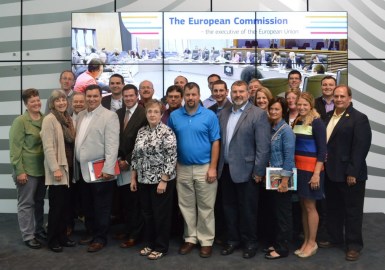
tradepic3(Indiana and Michigan Farm Bureau leaders visiting the European Commission in September 2015 as part of the Agricultural Leadership Exchange)
So why highlight trade?  Given the dire tone and negative rhetoric that surrounds this issue and the fact that every presidential candidate seems vehemently opposed to trade while proposing a seemingly isolationist political stance, you’d think I might consider spending my time on something else.

Well, let us briefly consider a few facts about trade and its role in Indiana for perspective:

  • Indiana ranks 8th among the 50 U.S. states in the value of its agricultural exports
  • Indiana’s agricultural exports reached an estimated $4.8 billion in 2013, up from $3.8 billion in 2009
  • Indiana’s agriculture exports support roughly 36,200 jobs
  • Nearly 1 out of every 3 acres of soybeans planted in Indiana are destined for export markets
  • Indiana’s top five agricultural exports are: 1. Soybeans – $1.7 billion 2. Soybean meal – $442 million 3. Feeds and fodder – $429 million 4. Corn – $410 million 5. Pork – $307 million

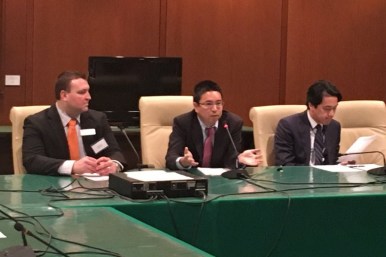
tradepic4(Over 50 Indiana Farm Bureau members met with officials from the Embassy of Japan during the 2016 INFB Leader Trip to Washington, D.C. in March to discuss trade and TPP)

We frequently hear opponents to new trade agreements argue that trade benefits agriculture at the expense of other industries.  However, a closer look at the collective economic impacts in Indiana seem to show a different picture as noted by the U.S. Chamber of Commerce:

  • More than 800,000 Indiana jobs depend on trade and the state’s exports have approached $50 billion annually in recent years.
  • Trade does not only benefit large multi-national corporations. Of the 8,258 Indiana companies that export, 85% were small or medium-sized firms.
  • Among those leading the charge is the auto sector. Exports of motor vehicles increased by an impressive 89% between 2009 and 2014, topping 2 million cars and trucks for the first time in 2014. U.S.-built cars shipped to China have risen sevenfold since 2009.

Given these realities, it is apparent that expanded international market and exporting opportunities for Indiana farms and businesses will result in added economic value and benefit.

Because of the important role trade plays to the success and viability of Hoosier farmers, Indiana Farm Bureau is encouraging its members to join in the efforts to promote trade opportunities for agriculture and emphasize the need for congress to pass the Trans-Pacific Partnership (TPP) and Trans-Atlantic Trade and Investment Partnership (TTIP).

There are many ways Farm Bureau members can participate in the World Trade Month campaign.  A list of resources and information (including most of the trade facts above) can be found at the Indiana Farm Bureau World Trade Month website, including a few suggestions for helping INFB with its trade advocacy efforts.  You can also find a social media script to help you get involved on Facebook and Twitter, following #WorldTradeMonth.

I hope that you will take a moment to join the conversation and inject some Hoosier common-sense into the ongoing trade debate.