Setting the Stage for the Next Farm Bill

Over the years, the agriculture industry and farming have evolved in very positive ways, but have also faced a myriad of growing economic, environmental and social challenges that did not exist at the levels they do today. As a result, there is no shortage of policy issues for the modern farmer and agricultural advocate to engage. For example, environmental policy and regulatory pressures, transportation and infrastructure funding, international trade, tax reform, immigration, healthcare and energy, just to name a few.

However, despite all of these growing complexities and issues impacting the farm, one policy issue continues to stand above the rest, and that of course is the farm bill. Over the last several months, agriculture and non-agricultural groups alike have been lining up to make statements, publish reports, and blast the airwaves with the issues of the farm bill they find most important to their members or stakeholders.

Farm Bureau is also in the process of taking deliberate steps to ensure that the farm bill continues to work for the American farmer. The American Farm Bureau Federation (AFBF) has appointed an advisory group consisting of state staff, including Indiana, to discuss what’s working in the current farm bill and what isn’t. The working group, along with AFBF staff, has published over 50 policy background papers and several videos on various issues and individual titles of the farm bill for farmer members to review. The goal is to prepare farmers for discussions about what they would like to see in the next farm bill so that Farm Bureau can effectively advocate for their needs.

At the state level, Indiana Farm Bureau (INFB) is also developing a process to receive grassroots feedback and policy to shape the next farm bill. A survey has been launched for Indiana Farm Bureau members, a state-level working group has been established consisting of farmer volunteers, and a series of educational seminars and listening sessions have been scheduled with partners at Purdue University. All of these activities culminate to the annual INFB state convention in December, where there will be a farm bill listening session followed by the delegate session where policies will be considered and voted on.

Many other state Farm Bureaus are also planning similar activities and outreach to their farmer members and families. If you live outside of Indiana, you are encouraged to contact your own state Farm Bureau staff to learn more.

There is no doubt that we are going through challenging times in farm country right now. Many farm families are dipping into reserves as they face prices at break-even levels or below. According to the USDA, net farm income for 2016 is at $54.8 billion, compared to $123.3 billion in 2013. Despite these harsh realities, there is no shortage of critics calling attention to the amount of risk management funds going to farm families at this critical time. Yet this is exactly how the farm safety net is designed to work. It pays during times of serious economic decline and does not pay out when the farm economy is on more sound footing. Current budget projections indicate we are likely to have less money to spend on the next farm bill than we had when we wrote the last one. So farmer engagement and grassroots feedback is more critical than ever to assist Farm Bureau in the prioritization of programs.

AFBF President Zippy Duvall has used the metaphor of the farm bill as a barn-raising. He states that “this barn raising is one of the biggest events coming up on the ag calendar, and it’s important that we do everything in our power to make sure Congress gets it right, with squared-up corners and leveled-up beams.” A proper barn-raising in this context is not complete or successful without the participation of the entire community. Farm Bureau and agriculture need farmers to step up and ensure that our collective futures are served by a properly functioning national farm policy. Take the first step and check out the resources and activities that can help you engage and shape this future by visiting http://www.fb.org/farmbillresources/.
A Day (or Three) in the Life of a Lobbyist

Welcome back to Hoosier on the Hill!

In this post, I highlight my recent trip to Washington, D.C., which took place earlier this week.  While it is difficult to pinpoint a typical day as a lobbyist, this trip provides a pretty good flavor for some typical activities on the job.

Day 1
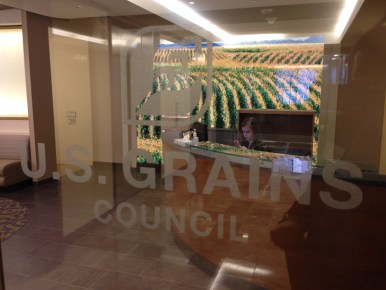
Tuesday was primarily focused on issue education, research and relationship building. After landing at the airport and taking the metro directly to the hotel, I checked in, dropped off my bag and headed off to my first meeting at the U.S. Grains Council (USGC).
A little bit of history for you, the USGC was founded in 1960 as a private, non-profit corporation with 10 international offices and programs in more than 50 countries. Its membership includes producer organizations and agribusinesses with a common interest in developing export markets primarily for U.S. barley, corn, grain sorghum and related products, including ethanol and distiller’s dried grains with solubles (DDGS).  The mission of the USGC is to develop markets, enable trade and improve lives.
IMG_3986
The focus of my meeting at the USGC was on international trade, a high priority issue for Indiana Farm Bureau and our 72,000 farmer members. The USGC is a partner with Farm Bureau in the Trade Benefits America and U.S. Coalition for Trans-Pacific Partnership (TPP), a broad-based and cross-sectoral coalition of U.S. companies and organizations urging Congress to pass TPP.  I had the opportunity to meet with USGC’s Director of Trade Policy to discuss the latest trade-related updates and other upcoming activities of mutual interest. Trade will continue to be a priority issue over the course of the year for Farm Bureau.  In fact, May is World Trade Month, and my next blog post will cover some of the activities and resources available to INFB members to promote this important issue.

After the meeting at USGC, I headed outside to order an Uber and fought D.C. traffic to get to my next meeting in the Georgetown area.  I quickly shifted my attention from trade and TPP to livestock issues.  This meeting consisted of a discussion related to the latest major announcements by large food manufacturers and retail companies regarding animal welfare requirements, namely cage-free eggs. We also touched on the proposed rule from the USDA related to animal welfare requirements for organic livestock producers.  Farm Bureau continues to evaluate the proposed rule for impacts, but has already requested an extension to the comment period to ensure the USDA receives adequate feedback from the producers as well as the general public.

Day 2
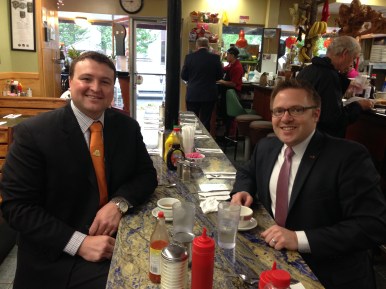
Before my busy day of meetings on Capitol Hill, I had a chance to meet up with a friend and colleague from the Michigan Farm Bureau, John Kran, for breakfast at Pete’s Diner.  Pete’s is one of John Boehner’s favorite breakfast spots and word has it, a favorite of other members of congress.  So we thought we’d give it a try.  While very small and unassuming, Pete’s provides basic but tasty comfort food for a good price.  I recommend the omelets which come standard with a side of French fries.  It’s always great to get together with our friends from other state Farm Bureaus and hear the latest issues impacting their members.
IMG_4004
A day on Capitol Hill is always very fast-paced and requires close attention to the schedule, time and the issues that we want our members of congress to hear about.  I visited with each office in the Indiana congressional delegation on several issues including biotechnology labeling, trade, rail infrastructure and the Affordable Care Act.

After being on the job for nearly three years (boy does time fly!), I listened to my wife and slowed down between meetings to snap a few pictures of my surroundings, which I know I’m guilty of taking for granted from time to time.

Day 3
On Thursday, I attended a training session at AFBF on the topic of grassroots engagement.  The AFBF public policy staff probably described the primary job functions of a lobbyist best:

  • Education (of others as well as yourself)
  • Sales
  • Research
  • Public relations and communications
  • Networking and relationship building and management

As I reviewed the list, I realized that I touched on all five functions during the course of my trip.  The training also included best practices for member advocacy and engagement, the do’s and don’ts from the congressional staff perspective, Capitol Hill visits, a simulation of what it is like to be a member of Congress and how to tell effective stories (guidelines taken directly from the Disney model).

After a full day of training, I grabbed my suitcase and descended down the long escalator to the metro to go back to the airport.  Upon reaching my departure gate, I met up with Senator Joe Donnelly and had a chance to briefly catch up before boarding the plane.  After a smooth flight to Indy and another hour and 15 minute drive, I finally arrived home around 10:00 p.m. where I was met at the doorstep by my three favorite people, anxiously waiting to hear all about my trip and discover what goodies I brought home in my suitcase.  Just another day in my life as a lobbyist.

Grassroots Advocacy in Action

Welcome!

I am Kyle Cline, your Hoosier on the Hill.  I’m excited to get this blog going and share my passion for public policy, government and all things agriculture.  I will be your host as we examine the issues and stories coming out of Washington, D.C. that impact American farmers and their rural communities.  In this first post, I highlight the annual Indiana Farm Bureau Leader Trip to Washington, D.C.

2-DC trip-DSC_7087-JAW

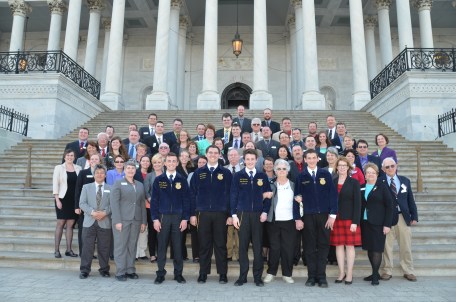
Each year, Indiana Farm Bureau members descend on Capitol Hill for the annual Leader Trip to Washington, D.C.  This trip is a prime opportunity for INFB members to participate in leadership development, issue education and to engage in some good old fashioned grassroots advocacy, including visits with their federal elected officials.  This year, the Leader Trip took place March 22-24 and included participation from 56 members.

The agenda may change from year to year, but the Leader Trip always includes plenty of opportunities for education on Farm Bureau’s national priority issues.  On day 1, our members arrived bright and early in Washington, D.C. and were greeted by the colorful cherry blossoms which were on full display the entire week.  Our first stop was a visit to the American Farm Bureau Federation. Members learned about the latest legislative and regulatory updates on some of the most pressing agricultural issues including biotechnology and GMO labeling, regulatory reform, trade and Trans-Pacific Partnership (TPP), farm policy and tax reform.  After hearing from INFB staff on advocacy “best practices” and planning their congressional visits for the next day, the Leader Trip participants set off on foot for the USDA, where the group heard from Acting Deputy Secretary Michael Scuse, Assistant Secretary for Congressional Relations Todd Batta, and Farm Service Agency Administrator Val Dolcini.  The discussions during this segment included international trade and TPP, farm policy, conservation and many other current issues.  Following the briefings, Leader Trip participants had an unexpected opportunity to tour USDA Secretary Vilsack’s office, which was possible because the secretary happened to be visiting Cuba with the president and other leaders.

haugheecapture nagaicapture

Day 2 of the Leader Trip was the official Capitol Hill Day.  Farm Bureau members took their new knowledge as well as their own unique perspectives and stories from their farms and communities and delivered a grassroots message to Congress about the importance of agriculture.  Members were organized in groups by congressional districts and had the opportunity to meet with their congressman/congresswoman to ask them for their support on Farm Bureau’s priority issues and legislation.

brookscapture

Representatives Luke Messer and Susan Brooks even took a few minutes away from their busy schedules to talk to us about the importance of constituent involvement in the legislative process and how office visits in D.C. are helpful to their work.  Their message re-confirms the positive difference that Farm Bureau and its members are making everyday.

messercapture

In the afternoon, our group visited the Senate Agriculture Committee and heard from Chief Economist Matt Erickson and Chief Counsel Anne Hazlett, both Hoosiers making a big difference on Capitol Hill for agriculture.  Last but not least, the group met up with the Iowa Farm Bureau in the afternoon for a session on renewable fuels and the future of farm policy.  Iowa Farm Bureau members were in town for their own version of the Leader Trip.

On Day 3, our members grabbed their passports and went global by paying a visit to the Embassy of Japan.  As an important trading partner and key nation in the proposed TPP, a visit with Japan made perfect sense.  Much of the discussion with Japanese officials focused on TPP and the importance of ensuring passage by Congress before the end of the year.  Japan plans to consider TPP for a vote in their parliament likely sometime in early summer.  The discussion was a good reminder to our members about how important international trade is to their bottom lines and profitability on the farm.  In a time when farm incomes have dropped 56% since 2013, more trade and market access for our products will be needed to get out of the hard times.  In Indiana alone, AFBF estimates an increase in cash receipts by $196 million and net exports by $98.3 million annually.  The largest gains will be in the soybean, corn, pork and beef sectors.

Overall, the 2016 Leader Trip was a success.  It is inspiring to me and the rest of the INFB staff to see current and future Farm Bureau leaders taking ownership of their destiny as they become effective advocates for agriculture.  It is empowering to see the effects of grassroots advocacy in action and the difference Farm Bureau makes when a few of us come together around a common cause.