Setting the Stage for the Next Farm Bill

Over the years, the agriculture industry and farming have evolved in very positive ways, but have also faced a myriad of growing economic, environmental and social challenges that did not exist at the levels they do today. As a result, there is no shortage of policy issues for the modern farmer and agricultural advocate to engage. For example, environmental policy and regulatory pressures, transportation and infrastructure funding, international trade, tax reform, immigration, healthcare and energy, just to name a few.

However, despite all of these growing complexities and issues impacting the farm, one policy issue continues to stand above the rest, and that of course is the farm bill. Over the last several months, agriculture and non-agricultural groups alike have been lining up to make statements, publish reports, and blast the airwaves with the issues of the farm bill they find most important to their members or stakeholders.

Farm Bureau is also in the process of taking deliberate steps to ensure that the farm bill continues to work for the American farmer. The American Farm Bureau Federation (AFBF) has appointed an advisory group consisting of state staff, including Indiana, to discuss what’s working in the current farm bill and what isn’t. The working group, along with AFBF staff, has published over 50 policy background papers and several videos on various issues and individual titles of the farm bill for farmer members to review. The goal is to prepare farmers for discussions about what they would like to see in the next farm bill so that Farm Bureau can effectively advocate for their needs.

At the state level, Indiana Farm Bureau (INFB) is also developing a process to receive grassroots feedback and policy to shape the next farm bill. A survey has been launched for Indiana Farm Bureau members, a state-level working group has been established consisting of farmer volunteers, and a series of educational seminars and listening sessions have been scheduled with partners at Purdue University. All of these activities culminate to the annual INFB state convention in December, where there will be a farm bill listening session followed by the delegate session where policies will be considered and voted on.

Many other state Farm Bureaus are also planning similar activities and outreach to their farmer members and families. If you live outside of Indiana, you are encouraged to contact your own state Farm Bureau staff to learn more.

There is no doubt that we are going through challenging times in farm country right now. Many farm families are dipping into reserves as they face prices at break-even levels or below. According to the USDA, net farm income for 2016 is at $54.8 billion, compared to $123.3 billion in 2013. Despite these harsh realities, there is no shortage of critics calling attention to the amount of risk management funds going to farm families at this critical time. Yet this is exactly how the farm safety net is designed to work. It pays during times of serious economic decline and does not pay out when the farm economy is on more sound footing. Current budget projections indicate we are likely to have less money to spend on the next farm bill than we had when we wrote the last one. So farmer engagement and grassroots feedback is more critical than ever to assist Farm Bureau in the prioritization of programs.

AFBF President Zippy Duvall has used the metaphor of the farm bill as a barn-raising. He states that “this barn raising is one of the biggest events coming up on the ag calendar, and it’s important that we do everything in our power to make sure Congress gets it right, with squared-up corners and leveled-up beams.” A proper barn-raising in this context is not complete or successful without the participation of the entire community. Farm Bureau and agriculture need farmers to step up and ensure that our collective futures are served by a properly functioning national farm policy. Take the first step and check out the resources and activities that can help you engage and shape this future by visiting http://www.fb.org/farmbillresources/.

USDA Lockup: A Farmer’s Viewpoint

img_2269

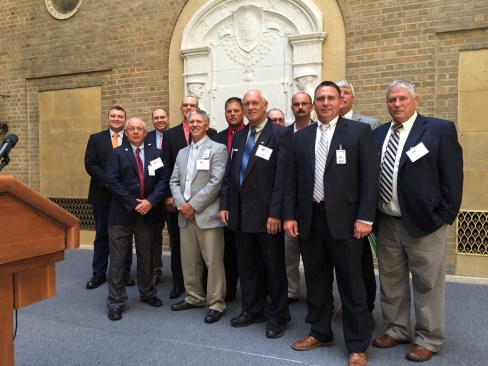
I had the opportunity to once again lead 12 farmers on a trip to Washington, D.C. to attend the USDA Lockup and Crop Report. I’m changing things up a little this week by showcasing one of the farmers who participated in the trip. Below is C.J. Fleenor’s guest blog post:

Recently, I was given the opportunity to cross an event off my “Bucket List.” We all have one: that list of random things we would like to accomplish, achieve or experience at some point. Washington, D.C., is truly an amazing city. I have been fortunate to travel there several times over the last few years, but there was still one thing I had not experienced…

The “D.C. Lockup.”

As farmers and people in agriculture, we know of the crop reports released by WASDE and NASS. It has always fascinated me how those reports can make billion-dollar changes in our pocketbooks and the general global economy.

When my regional manager approached me about Farm Bureau sponsoring an annual trip for the lockup, I didn’t think twice when I said “YES!” This was an opportunity to cross a bucket list item off for sure. However, I didn’t realize just how much went into that report. Nor did I realize how little was analyzed for such a monumental monthly document.

The Indiana Farm Bureau delegation, led by Kyle Cline, left on Thursday. Our day started with AFBF and a brief discussion on upcoming hot topics. From there, we travelled to the office of Chuck Conner and the National Council of Farmer Cooperatives, and visited the Canadian Embassy. We discussed U.S. agricultural issues, presidential politics and the importance of the TPP and trade. Our day was capped off with dinner and sightseeing of the beautiful city at night.

Friday, we headed to the USDA. After going through extensive security, we entered the pre-lockup room. There, we deposited any electronics, phones, watches, key fobs, etc., into lockers. Then we heard from NASS employees on how the report is generated. This is where I realized that more than 20,000 points of corn are gathered…equaling up to five acres total of corn. (It’s only one acre of soybeans!) From these sample sites, test weights, kernel quality, yield, etc., are gathered each month.

Then we experience the lock-up.

11 a.m. After passing through an electromagnetic scanner and two sets of locked doors, we hear from statisticians and get a tour. They come in to analyze the data and compile the report just before midnight and can’t leave until the report is released.

11:30 a.m.: We enter the briefing room, where we read the report and speculate on its impact on the markets.

11:45 a.m.: The secretary of agriculture or his designee – in our case, the chief economist – enters the room and the official briefing begins.

Noon: The report is released and the statisticians may leave.

Everything concludes by 12:30 p.m. There were no windows, no doors outside and no communication with the outside world.

I always envisioned this as a general media report; the briefing aspect was interesting. It was a true government briefing, and we were there to witness as the chief economist realized the impact that the decreased expected fall price would have upon ARC and PLC payments, among other supply/demand concerns.

Ultimately, this was a once in a lifetime opportunity, and I would strongly encourage any member to consider attending. The security, the process, the methodology and the presentation were amazing. Not to mention getting to read a copy of the August crop report before anybody else had! I greatly appreciate Kyle and the Indiana Farm Bureau allowing me this opportunity!
C.J. Fleenor, Orange County Farm Bureau President
img_2272

The Scoop on August Recess

Capitol-Reflection

Every August, federal lawmakers return home to meet with constituents and spend time with family during what is commonly known as the congressional “August recess,” also referred to as a congressional work period. These meetings offer citizens and organizations such as the Indiana Farm Bureau an opportunity to meet face-to-face with their senators and representatives and speak about the issues that are on their mind. For example, this year Farm Bureau’s top priority is the Trans-Pacific Partnership (TPP). Hoosier farmers are also talking about tax and regulatory reform. More information about INFB’s August Recess activities can be found on the website.

You might be wondering why Congress needs a special month-long break or the origin of this tradition. I found myself asking the same questions, so I decided to do a little research to learn more. I will save you all of the details by providing you with the link to the full story. But first, just a few highlights on the history of August Recess for those of you with limited time on your hands.

  • Congress has adjourned for summer breaks dating all the way back to 1791. Of course, it wasn’t until the 20th century that federal lawmaking was a full-time position. Until that time, lawmakers worked other jobs as well, including many farmers.
  • In 1841 congress experienced its first full Washington summer due to an usually large work load. Shortly after the start of the 20th century, this became normal practice (imagine that for a moment, D.C. in the summertime with no air-conditioning!).
  • A mandated recess was so important to congress that it passed the Legislative Reorganization Act in 1970, establishing August recess in statute. You might think of it as America’s only required vacation.
  • The reason for this change had to do with the fact that junior members of congress with young families lobbied more senior members for more predictability in the legislative schedule so they could plan their vacations and ensure valuable time spent with their spouses and children.
  • The late 1960’s were especially tasking on congressional members given a series of notable activities that demanded their time such as the Vietnam War, President Lyndon B. Johnson’s “war on poverty” and social reform agenda.
  • Under the constitution, the Senate and House cannot recess for more than 3 days without the other’s permission.
  • In addition to meeting with constituents back home, members have the opportunity to spend some well-deserved time off with family as well.

Congress Sends GMO Labeling Bill To President

Last week, the U.S. House passed S. 764, the Roberts/Stabenow biotechnology food labeling bill, by a vote of 306-117.  The vote included 205 Republicans and 101 Democrats voting in the affirmative, including the entire Indiana Congressional Delegation with exception of Congressman Luke Messer.  The bill establishes federal pre-emption of state-by-state mandatory GMO labeling laws while providing consumers with information about their food that is balanced and accurate.

Indiana Farm Bureau supported the measure and thanks all members voting in favor of S. 764.  The House vote last week followed passage of the same bill in the Senate just a week prior and ended a nearly year-long negotiation and debate that included many starts and stops.  Both Senators Donnelly and Coats supported the measure.

See the previous blog post “Big Week Ahead for Biotech” for a brief summary of the legislation.

Big Week Ahead for Biotech

After months of negotiations, Senate leaders finally reached a historic deal in late June to set national labeling standards for foods that contain genetically engineered ingredients.

The agreement between Senate Agriculture Chairman Pat Roberts and ranking Democrat Debbie Stabenow caps off a long and winding path of negotiations that included a series of starts and stops.  Farm Bureau is supporting the Roberts-Stabenow GMO food labeling compromise and is currently asking members to contact Congress to urge for the bill’s passage.

Below is a rundown of what the legislation would actually do:

  • The legislation would block Vermont’s GMO labeling law that took effect July 1, protecting interstate commerce. States would not be allowed to have labeling laws that differ from the federal standard.
  • It would require food companies to disclose biotech ingredients but provides one of three options for doing so: 1) a scannable code, such as the QR codes on labels that can be read by smartphones, 2) on-package symbol or 3) text on the package indicating the presence of biotechnology.
  • Small companies would be exempt from the labeling requirements.
  • Meat and dairy products also would be exempt from the disclosure standards. Eating biotech feed wouldn’t be enough to qualify as a biotech product.
  • Provides USDA the authority to determine what on-package disclosure will look like.
  • Includes a narrow and strong definition of biotechnology that protects future breeding technologies from being stigmatized as being GMO.
  • Establishes that a manufacturer cannot label a product as non-GMO simply because it is not subject to the bill’s labeling requirements.
  • Also establishes that products already qualified as certified organic will be able to market as non-GMO.
  • Saves the average consumer hundreds of dollars each year.

Time is limited for Congress to take action on the legislation prior to July 15, when both chambers are scheduled for an extended break due to party conventions and August Recess. However, the process for approval is already underway.  Last week, the Senate voted 68-29 on a procedural motion that initiates the process for floor action.  There will be one more procedural vote to “invoke cloture”  followed by final consideration and a vote on the bill, which may take place next Friday, July 8 according to sources.  Assuming everything goes as anticipated, the House is expected to take action on the legislation during the week of July 11.


#WorldTradeMonth

The month of May means different things to different people.  In Indiana, Hoosiers may consider the Indianapolis 500 and its many festivities, planting season being in full swing or the approaching end of the school year.  You may not be aware that May is also World Trade Month.  Indiana Farm Bureau is taking this opportunity to highlight the numerous benefits of trade to Indiana’s farmers, rural communities and the general economy.
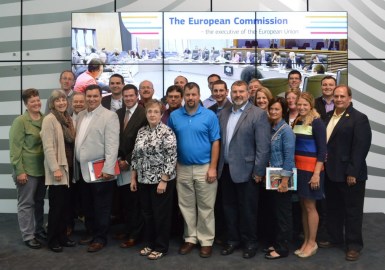
tradepic3(Indiana and Michigan Farm Bureau leaders visiting the European Commission in September 2015 as part of the Agricultural Leadership Exchange)
So why highlight trade?  Given the dire tone and negative rhetoric that surrounds this issue and the fact that every presidential candidate seems vehemently opposed to trade while proposing a seemingly isolationist political stance, you’d think I might consider spending my time on something else.

Well, let us briefly consider a few facts about trade and its role in Indiana for perspective:

  • Indiana ranks 8th among the 50 U.S. states in the value of its agricultural exports
  • Indiana’s agricultural exports reached an estimated $4.8 billion in 2013, up from $3.8 billion in 2009
  • Indiana’s agriculture exports support roughly 36,200 jobs
  • Nearly 1 out of every 3 acres of soybeans planted in Indiana are destined for export markets
  • Indiana’s top five agricultural exports are: 1. Soybeans – $1.7 billion 2. Soybean meal – $442 million 3. Feeds and fodder – $429 million 4. Corn – $410 million 5. Pork – $307 million

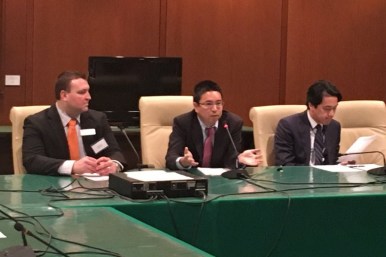
tradepic4(Over 50 Indiana Farm Bureau members met with officials from the Embassy of Japan during the 2016 INFB Leader Trip to Washington, D.C. in March to discuss trade and TPP)
We frequently hear opponents to new trade agreements argue that trade benefits agriculture at the expense of other industries.  However, a closer look at the collective economic impacts in Indiana seem to show a different picture as noted by the U.S. Chamber of Commerce:

  • More than 800,000 Indiana jobs depend on trade and the state’s exports have approached $50 billion annually in recent years.
  • Trade does not only benefit large multi-national corporations. Of the 8,258 Indiana companies that export, 85% were small or medium-sized firms.
  • Among those leading the charge is the auto sector. Exports of motor vehicles increased by an impressive 89% between 2009 and 2014, topping 2 million cars and trucks for the first time in 2014. U.S.-built cars shipped to China have risen sevenfold since 2009.

Given these realities, it is apparent that expanded international market and exporting opportunities for Indiana farms and businesses will result in added economic value and benefit.

Because of the important role trade plays to the success and viability of Hoosier farmers, Indiana Farm Bureau is encouraging its members to join in the efforts to promote trade opportunities for agriculture and emphasize the need for congress to pass the Trans-Pacific Partnership (TPP) and Trans-Atlantic Trade and Investment Partnership (TTIP).

There are many ways Farm Bureau members can participate in the World Trade Month campaign.  A list of resources and information (including most of the trade facts above) can be found at the Indiana Farm Bureau World Trade Month website, including a few suggestions for helping INFB with its trade advocacy efforts.  You can also find a social media script to help you get involved on Facebook and Twitter, following #WorldTradeMonth.

I hope that you will take a moment to join the conversation and inject some Hoosier common-sense into the ongoing trade debate.

A Day (or Three) in the Life of a Lobbyist

Welcome back to Hoosier on the Hill!

In this post, I highlight my recent trip to Washington, D.C., which took place earlier this week.  While it is difficult to pinpoint a typical day as a lobbyist, this trip provides a pretty good flavor for some typical activities on the job.

Day 1
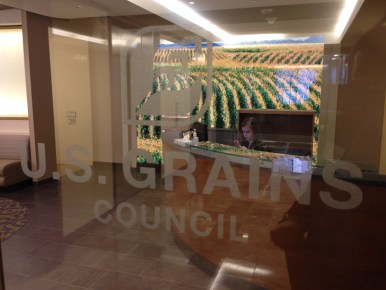
Tuesday was primarily focused on issue education, research and relationship building. After landing at the airport and taking the metro directly to the hotel, I checked in, dropped off my bag and headed off to my first meeting at the U.S. Grains Council (USGC).
A little bit of history for you, the USGC was founded in 1960 as a private, non-profit corporation with 10 international offices and programs in more than 50 countries. Its membership includes producer organizations and agribusinesses with a common interest in developing export markets primarily for U.S. barley, corn, grain sorghum and related products, including ethanol and distiller’s dried grains with solubles (DDGS).  The mission of the USGC is to develop markets, enable trade and improve lives.
IMG_3986
The focus of my meeting at the USGC was on international trade, a high priority issue for Indiana Farm Bureau and our 72,000 farmer members. The USGC is a partner with Farm Bureau in the Trade Benefits America and U.S. Coalition for Trans-Pacific Partnership (TPP), a broad-based and cross-sectoral coalition of U.S. companies and organizations urging Congress to pass TPP.  I had the opportunity to meet with USGC’s Director of Trade Policy to discuss the latest trade-related updates and other upcoming activities of mutual interest. Trade will continue to be a priority issue over the course of the year for Farm Bureau.  In fact, May is World Trade Month, and my next blog post will cover some of the activities and resources available to INFB members to promote this important issue.

After the meeting at USGC, I headed outside to order an Uber and fought D.C. traffic to get to my next meeting in the Georgetown area.  I quickly shifted my attention from trade and TPP to livestock issues.  This meeting consisted of a discussion related to the latest major announcements by large food manufacturers and retail companies regarding animal welfare requirements, namely cage-free eggs. We also touched on the proposed rule from the USDA related to animal welfare requirements for organic livestock producers.  Farm Bureau continues to evaluate the proposed rule for impacts, but has already requested an extension to the comment period to ensure the USDA receives adequate feedback from the producers as well as the general public.

Day 2
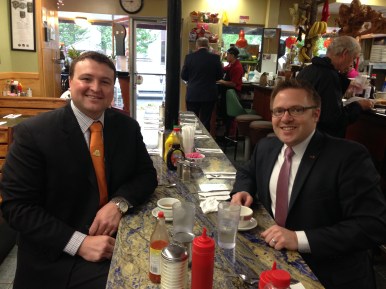
Before my busy day of meetings on Capitol Hill, I had a chance to meet up with a friend and colleague from the Michigan Farm Bureau, John Kran, for breakfast at Pete’s Diner.  Pete’s is one of John Boehner’s favorite breakfast spots and word has it, a favorite of other members of congress.  So we thought we’d give it a try.  While very small and unassuming, Pete’s provides basic but tasty comfort food for a good price.  I recommend the omelets which come standard with a side of French fries.  It’s always great to get together with our friends from other state Farm Bureaus and hear the latest issues impacting their members.
IMG_4004
A day on Capitol Hill is always very fast-paced and requires close attention to the schedule, time and the issues that we want our members of congress to hear about.  I visited with each office in the Indiana congressional delegation on several issues including biotechnology labeling, trade, rail infrastructure and the Affordable Care Act.

After being on the job for nearly three years (boy does time fly!), I listened to my wife and slowed down between meetings to snap a few pictures of my surroundings, which I know I’m guilty of taking for granted from time to time.

Day 3
On Thursday, I attended a training session at AFBF on the topic of grassroots engagement.  The AFBF public policy staff probably described the primary job functions of a lobbyist best:

  • Education (of others as well as yourself)
  • Sales
  • Research
  • Public relations and communications
  • Networking and relationship building and management

As I reviewed the list, I realized that I touched on all five functions during the course of my trip.  The training also included best practices for member advocacy and engagement, the do’s and don’ts from the congressional staff perspective, Capitol Hill visits, a simulation of what it is like to be a member of Congress and how to tell effective stories (guidelines taken directly from the Disney model).

After a full day of training, I grabbed my suitcase and descended down the long escalator to the metro to go back to the airport.  Upon reaching my departure gate, I met up with Senator Joe Donnelly and had a chance to briefly catch up before boarding the plane.  After a smooth flight to Indy and another hour and 15 minute drive, I finally arrived home around 10:00 p.m. where I was met at the doorstep by my three favorite people, anxiously waiting to hear all about my trip and discover what goodies I brought home in my suitcase.  Just another day in my life as a lobbyist.