
Last week I had the opportunity to travel to Memphis, Tennessee to participate in the annual American Farm Bureau Federation (AFBF) Environmental Issues Conference. I joined fellow AFBF and state Farm Bureau staff from all over the country for a few days focused on all things environmental policy and regulation, which has increasingly become the hot topic the agriculture community
On day 1, we discussed various topics including the challenges and opportunities facing the agriculture community in regards to nutrient management strategies, loss reduction and conservation. One of the most beneficial and interesting portions of the meeting for me was when each state provided a brief update on conservation projects and activities occurring back at home. It was encouraging to hear all of the voluntary initiatives that state Farm Bureaus and other leaders are spearheading to help farmersimprove watershed and wildlife habitat health while improving yields and production and enhancing the economics of farming. For more information or examples of voluntary state programs where farmers are taking responsibility for improving water quality, I’d encourage you to check out some information related to Indiana including Impact Indiana, ISDA, and Purdue University. Other good examples outside of the Hoosier state are Ohio, Michigan, Illinois and Florida.
The following day of the conference, our group set out on a tour bus to observe many of the issues and topics we had discussed the day before. The Mississippi Farm Bureau pulled out all the stops for us, including some great farm visits, delicious southern food and some history and culture along the way. They even special ordered the bus just for me!
 We spent the day along the Mississippi Delta visiting with farmers and extension researchers who are passionate about nutrient loss reduction and conservation, including Buddy Allen of M&B Farms. Buddy gave our group a presentation on his innovative closed system tail water recovery system where he is collecting water runoff into a pond, capturing the nutrients and reapplying them to his rice fields, improving water quality downstream while reducing his input costs on the farm.

Buddy also gave us a briefing on the various soil types found in the Mississippi Delta region, which can vary significantly depending on location and proximity to the river. (On a side note, it was really cool for this Hoosier farm boy to see rice and cotton growing in the field, a first for me.)
The next stop was Dundee, MS, where our group visited with Darrin Dodds and Trent Irby of MSU Extension. The purpose of this research plot is to investigate Palmer Amaranth (aka pigweed) and Duo/Enlist management as well as drift control techniques for dealing with this nasty weed on the farm. Even though pigweed got its start in the south, it has emerged in the last few years in the Hoosier state and is an issue that some of our farmers are forced to manage now.

After our visit to the MSU Extension research plot, the Mississippi Farm Bureau treated us to some outstanding southern barbecue courtesy of the Hopson Commissary, a restaurant now housed at a former cotton plantation. Hopson Commissary is located in Clarksdale, MS, home of Muddy Waters, iconic blues musician and father of the Chicago blues. Clarksdale is a key stop along the “Blues Highway” and has been showcased by National Geographic and many other travel magazines.

The owner of Hopson provided a briefing to our group about the history of the plantation and its impressive place in agricultural history. According to the website, “In 1935 the Hopson Plantation began a monumental changeover to become one of the first completely mechanized cotton operations in the world. In the fall of 1944, International Harvester introduced the first cotton picker on the Hopson farm making it the first in the world to grow and harvest a commercial acreage of cotton produced completely by mechanical methods.”
In addition to outstanding food and live music, Hopson also offers overnight accommodations which National Geographic has also recommended to tourists. The Shack Up Inn “is a collection of restored sharecropper shacks and boutique hotel rooms built inside renovated cotton bins”.
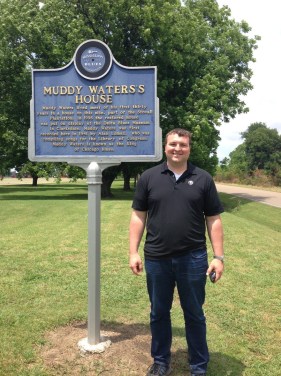
After lunch, we visited the Stovall Plantation, birthplace of Muddy Waters. While the cabin in which Muddy Waters lived is not there, visitors can see the beautifully restored structure in the Delta Blues Museum in nearby Clarksdale. In addition to learning more about blues history, the stop also included a farm tour by Pete Hunter, who farms the land today. Pete told us about his conservation practices including two-stage ditches and water recovery systems.
Our final stop before dinner included a visit to Mid-South Ag Case IH where we learned about the latest and greatest technology from Case IH. Of particular interest to me was the new lineup of Patriot Sprayers that Case IH offers which tied into themes covered earlier in the day at the MSU research plot about drift control and precision spray applications.
After a long day of touring the Mississippi Delta, our group finished with a traditional southern dinner of fried catfish, okra, cole slaw and the kind of sweet ice tea that would make your dentist cringe. It was nice eating dinner on the banks of the Mississippi River at the Tunica Riverpark Museum.
Before I left Memphis to come back to Indiana, I wanted to make time to eat some barbecue at the iconic Rendezvous. I also had a chance to meet up with my friends Nick and Maria for dinner one evening at Gus’s for some out-of-this world fried chicken.

Nick participated in the Robert Bosch Fellowship the same year that I did (2012-2013), which sent both of us to Germany for a year of work, professional development, travel and seminars; an experience my family will never forget.
After a productive week, I headed to the airport to fly back to the Hoosier state to enjoy a nice, long Memorial Day weekend full of great weather and ironically enough…barbecue!
 Hoosier on the Hill