USDA Lockup: A Farmer’s Viewpoint

img_2269

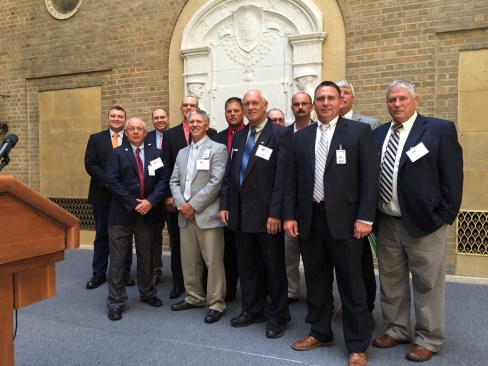
I had the opportunity to once again lead 12 farmers on a trip to Washington, D.C. to attend the USDA Lockup and Crop Report. I’m changing things up a little this week by showcasing one of the farmers who participated in the trip. Below is C.J. Fleenor’s guest blog post:

Recently, I was given the opportunity to cross an event off my “Bucket List.” We all have one: that list of random things we would like to accomplish, achieve or experience at some point. Washington, D.C., is truly an amazing city. I have been fortunate to travel there several times over the last few years, but there was still one thing I had not experienced…

The “D.C. Lockup.”

As farmers and people in agriculture, we know of the crop reports released by WASDE and NASS. It has always fascinated me how those reports can make billion-dollar changes in our pocketbooks and the general global economy.

When my regional manager approached me about Farm Bureau sponsoring an annual trip for the lockup, I didn’t think twice when I said “YES!” This was an opportunity to cross a bucket list item off for sure. However, I didn’t realize just how much went into that report. Nor did I realize how little was analyzed for such a monumental monthly document.

The Indiana Farm Bureau delegation, led by Kyle Cline, left on Thursday. Our day started with AFBF and a brief discussion on upcoming hot topics. From there, we travelled to the office of Chuck Conner and the National Council of Farmer Cooperatives, and visited the Canadian Embassy. We discussed U.S. agricultural issues, presidential politics and the importance of the TPP and trade. Our day was capped off with dinner and sightseeing of the beautiful city at night.

Friday, we headed to the USDA. After going through extensive security, we entered the pre-lockup room. There, we deposited any electronics, phones, watches, key fobs, etc., into lockers. Then we heard from NASS employees on how the report is generated. This is where I realized that more than 20,000 points of corn are gathered…equaling up to five acres total of corn. (It’s only one acre of soybeans!) From these sample sites, test weights, kernel quality, yield, etc., are gathered each month.

Then we experience the lock-up.

11 a.m. After passing through an electromagnetic scanner and two sets of locked doors, we hear from statisticians and get a tour. They come in to analyze the data and compile the report just before midnight and can’t leave until the report is released.

11:30 a.m.: We enter the briefing room, where we read the report and speculate on its impact on the markets.

11:45 a.m.: The secretary of agriculture or his designee – in our case, the chief economist – enters the room and the official briefing begins.

Noon: The report is released and the statisticians may leave.

Everything concludes by 12:30 p.m. There were no windows, no doors outside and no communication with the outside world.

I always envisioned this as a general media report; the briefing aspect was interesting. It was a true government briefing, and we were there to witness as the chief economist realized the impact that the decreased expected fall price would have upon ARC and PLC payments, among other supply/demand concerns.

Ultimately, this was a once in a lifetime opportunity, and I would strongly encourage any member to consider attending. The security, the process, the methodology and the presentation were amazing. Not to mention getting to read a copy of the August crop report before anybody else had! I greatly appreciate Kyle and the Indiana Farm Bureau allowing me this opportunity!
C.J. Fleenor, Orange County Farm Bureau President
img_2272

Big Week Ahead for Biotech

After months of negotiations, Senate leaders finally reached a historic deal in late June to set national labeling standards for foods that contain genetically engineered ingredients.

The agreement between Senate Agriculture Chairman Pat Roberts and ranking Democrat Debbie Stabenow caps off a long and winding path of negotiations that included a series of starts and stops.  Farm Bureau is supporting the Roberts-Stabenow GMO food labeling compromise and is currently asking members to contact Congress to urge for the bill’s passage.

Below is a rundown of what the legislation would actually do:

  • The legislation would block Vermont’s GMO labeling law that took effect July 1, protecting interstate commerce. States would not be allowed to have labeling laws that differ from the federal standard.
  • It would require food companies to disclose biotech ingredients but provides one of three options for doing so: 1) a scannable code, such as the QR codes on labels that can be read by smartphones, 2) on-package symbol or 3) text on the package indicating the presence of biotechnology.
  • Small companies would be exempt from the labeling requirements.
  • Meat and dairy products also would be exempt from the disclosure standards. Eating biotech feed wouldn’t be enough to qualify as a biotech product.
  • Provides USDA the authority to determine what on-package disclosure will look like.
  • Includes a narrow and strong definition of biotechnology that protects future breeding technologies from being stigmatized as being GMO.
  • Establishes that a manufacturer cannot label a product as non-GMO simply because it is not subject to the bill’s labeling requirements.
  • Also establishes that products already qualified as certified organic will be able to market as non-GMO.
  • Saves the average consumer hundreds of dollars each year.

Time is limited for Congress to take action on the legislation prior to July 15, when both chambers are scheduled for an extended break due to party conventions and August Recess. However, the process for approval is already underway.  Last week, the Senate voted 68-29 on a procedural motion that initiates the process for floor action.  There will be one more procedural vote to “invoke cloture”  followed by final consideration and a vote on the bill, which may take place next Friday, July 8 according to sources.  Assuming everything goes as anticipated, the House is expected to take action on the legislation during the week of July 11.


A Day (or Three) in the Life of a Lobbyist

Welcome back to Hoosier on the Hill!

In this post, I highlight my recent trip to Washington, D.C., which took place earlier this week.  While it is difficult to pinpoint a typical day as a lobbyist, this trip provides a pretty good flavor for some typical activities on the job.

Day 1
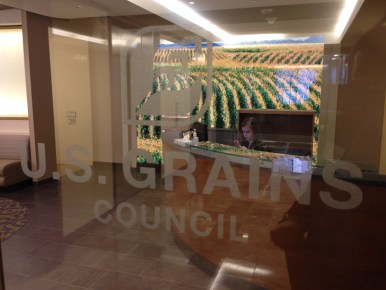
Tuesday was primarily focused on issue education, research and relationship building. After landing at the airport and taking the metro directly to the hotel, I checked in, dropped off my bag and headed off to my first meeting at the U.S. Grains Council (USGC).
A little bit of history for you, the USGC was founded in 1960 as a private, non-profit corporation with 10 international offices and programs in more than 50 countries. Its membership includes producer organizations and agribusinesses with a common interest in developing export markets primarily for U.S. barley, corn, grain sorghum and related products, including ethanol and distiller’s dried grains with solubles (DDGS).  The mission of the USGC is to develop markets, enable trade and improve lives.
IMG_3986
The focus of my meeting at the USGC was on international trade, a high priority issue for Indiana Farm Bureau and our 72,000 farmer members. The USGC is a partner with Farm Bureau in the Trade Benefits America and U.S. Coalition for Trans-Pacific Partnership (TPP), a broad-based and cross-sectoral coalition of U.S. companies and organizations urging Congress to pass TPP.  I had the opportunity to meet with USGC’s Director of Trade Policy to discuss the latest trade-related updates and other upcoming activities of mutual interest. Trade will continue to be a priority issue over the course of the year for Farm Bureau.  In fact, May is World Trade Month, and my next blog post will cover some of the activities and resources available to INFB members to promote this important issue.

After the meeting at USGC, I headed outside to order an Uber and fought D.C. traffic to get to my next meeting in the Georgetown area.  I quickly shifted my attention from trade and TPP to livestock issues.  This meeting consisted of a discussion related to the latest major announcements by large food manufacturers and retail companies regarding animal welfare requirements, namely cage-free eggs. We also touched on the proposed rule from the USDA related to animal welfare requirements for organic livestock producers.  Farm Bureau continues to evaluate the proposed rule for impacts, but has already requested an extension to the comment period to ensure the USDA receives adequate feedback from the producers as well as the general public.

Day 2
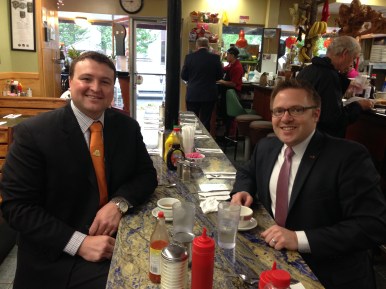
Before my busy day of meetings on Capitol Hill, I had a chance to meet up with a friend and colleague from the Michigan Farm Bureau, John Kran, for breakfast at Pete’s Diner.  Pete’s is one of John Boehner’s favorite breakfast spots and word has it, a favorite of other members of congress.  So we thought we’d give it a try.  While very small and unassuming, Pete’s provides basic but tasty comfort food for a good price.  I recommend the omelets which come standard with a side of French fries.  It’s always great to get together with our friends from other state Farm Bureaus and hear the latest issues impacting their members.
IMG_4004
A day on Capitol Hill is always very fast-paced and requires close attention to the schedule, time and the issues that we want our members of congress to hear about.  I visited with each office in the Indiana congressional delegation on several issues including biotechnology labeling, trade, rail infrastructure and the Affordable Care Act.

After being on the job for nearly three years (boy does time fly!), I listened to my wife and slowed down between meetings to snap a few pictures of my surroundings, which I know I’m guilty of taking for granted from time to time.

Day 3
On Thursday, I attended a training session at AFBF on the topic of grassroots engagement.  The AFBF public policy staff probably described the primary job functions of a lobbyist best:

  • Education (of others as well as yourself)
  • Sales
  • Research
  • Public relations and communications
  • Networking and relationship building and management

As I reviewed the list, I realized that I touched on all five functions during the course of my trip.  The training also included best practices for member advocacy and engagement, the do’s and don’ts from the congressional staff perspective, Capitol Hill visits, a simulation of what it is like to be a member of Congress and how to tell effective stories (guidelines taken directly from the Disney model).

After a full day of training, I grabbed my suitcase and descended down the long escalator to the metro to go back to the airport.  Upon reaching my departure gate, I met up with Senator Joe Donnelly and had a chance to briefly catch up before boarding the plane.  After a smooth flight to Indy and another hour and 15 minute drive, I finally arrived home around 10:00 p.m. where I was met at the doorstep by my three favorite people, anxiously waiting to hear all about my trip and discover what goodies I brought home in my suitcase.  Just another day in my life as a lobbyist.

Grassroots Advocacy in Action

Welcome!

I am Kyle Cline, your Hoosier on the Hill.  I’m excited to get this blog going and share my passion for public policy, government and all things agriculture.  I will be your host as we examine the issues and stories coming out of Washington, D.C. that impact American farmers and their rural communities.  In this first post, I highlight the annual Indiana Farm Bureau Leader Trip to Washington, D.C.

2-DC trip-DSC_7087-JAW

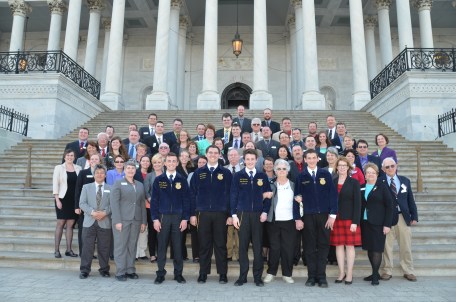
Each year, Indiana Farm Bureau members descend on Capitol Hill for the annual Leader Trip to Washington, D.C.  This trip is a prime opportunity for INFB members to participate in leadership development, issue education and to engage in some good old fashioned grassroots advocacy, including visits with their federal elected officials.  This year, the Leader Trip took place March 22-24 and included participation from 56 members.

The agenda may change from year to year, but the Leader Trip always includes plenty of opportunities for education on Farm Bureau’s national priority issues.  On day 1, our members arrived bright and early in Washington, D.C. and were greeted by the colorful cherry blossoms which were on full display the entire week.  Our first stop was a visit to the American Farm Bureau Federation. Members learned about the latest legislative and regulatory updates on some of the most pressing agricultural issues including biotechnology and GMO labeling, regulatory reform, trade and Trans-Pacific Partnership (TPP), farm policy and tax reform.  After hearing from INFB staff on advocacy “best practices” and planning their congressional visits for the next day, the Leader Trip participants set off on foot for the USDA, where the group heard from Acting Deputy Secretary Michael Scuse, Assistant Secretary for Congressional Relations Todd Batta, and Farm Service Agency Administrator Val Dolcini.  The discussions during this segment included international trade and TPP, farm policy, conservation and many other current issues.  Following the briefings, Leader Trip participants had an unexpected opportunity to tour USDA Secretary Vilsack’s office, which was possible because the secretary happened to be visiting Cuba with the president and other leaders.

haugheecapture nagaicapture

Day 2 of the Leader Trip was the official Capitol Hill Day.  Farm Bureau members took their new knowledge as well as their own unique perspectives and stories from their farms and communities and delivered a grassroots message to Congress about the importance of agriculture.  Members were organized in groups by congressional districts and had the opportunity to meet with their congressman/congresswoman to ask them for their support on Farm Bureau’s priority issues and legislation.

brookscapture

Representatives Luke Messer and Susan Brooks even took a few minutes away from their busy schedules to talk to us about the importance of constituent involvement in the legislative process and how office visits in D.C. are helpful to their work.  Their message re-confirms the positive difference that Farm Bureau and its members are making everyday.

messercapture

In the afternoon, our group visited the Senate Agriculture Committee and heard from Chief Economist Matt Erickson and Chief Counsel Anne Hazlett, both Hoosiers making a big difference on Capitol Hill for agriculture.  Last but not least, the group met up with the Iowa Farm Bureau in the afternoon for a session on renewable fuels and the future of farm policy.  Iowa Farm Bureau members were in town for their own version of the Leader Trip.

On Day 3, our members grabbed their passports and went global by paying a visit to the Embassy of Japan.  As an important trading partner and key nation in the proposed TPP, a visit with Japan made perfect sense.  Much of the discussion with Japanese officials focused on TPP and the importance of ensuring passage by Congress before the end of the year.  Japan plans to consider TPP for a vote in their parliament likely sometime in early summer.  The discussion was a good reminder to our members about how important international trade is to their bottom lines and profitability on the farm.  In a time when farm incomes have dropped 56% since 2013, more trade and market access for our products will be needed to get out of the hard times.  In Indiana alone, AFBF estimates an increase in cash receipts by $196 million and net exports by $98.3 million annually.  The largest gains will be in the soybean, corn, pork and beef sectors.

Overall, the 2016 Leader Trip was a success.  It is inspiring to me and the rest of the INFB staff to see current and future Farm Bureau leaders taking ownership of their destiny as they become effective advocates for agriculture.  It is empowering to see the effects of grassroots advocacy in action and the difference Farm Bureau makes when a few of us come together around a common cause.